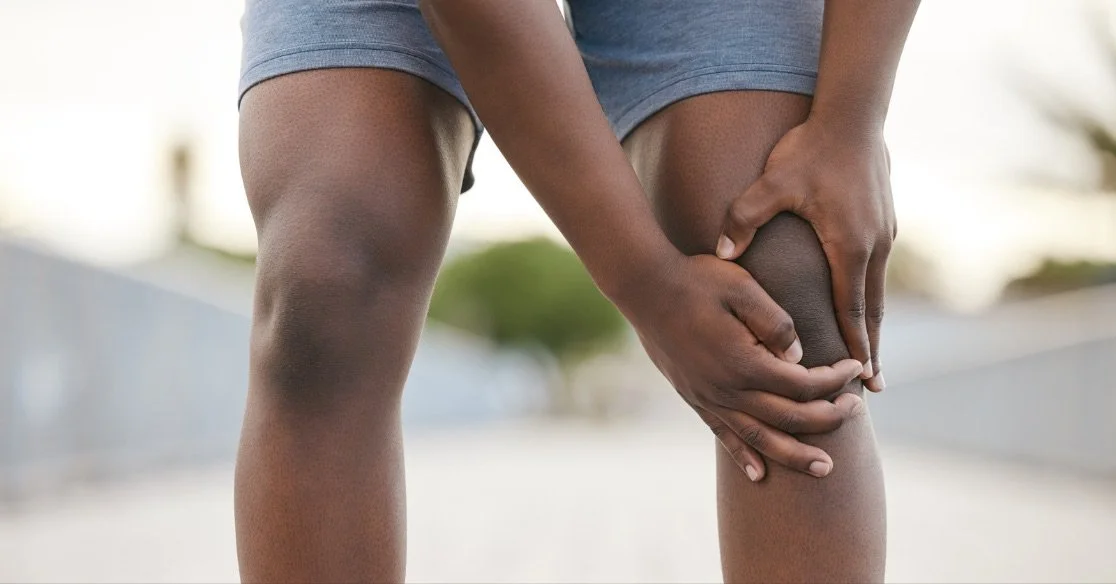
"How long until I can play again?" It's usually the first thing people ask us after hurting the inside of their knee, often before they've even sat down. The honest answer depends on how badly the ligament is damaged, and on whether anything else in the knee was hurt at the same time.
The encouraging part is that this ligament tends to heal well, thanks to its rich blood supply, and most people recover without surgery when their rehab is done properly. Here's what's actually happening inside your knee, and what recovery realistically looks like.
Who Gets MCL Injuries, and What They Feel Like
The medial collateral ligament (MCL) is a strong band of tissue running down the inside of your knee, connecting the thigh bone (femur) to the shin bone (tibia). Its main job is to stop the knee buckling inward. Sprains of the MCL are the most common ligament injury to the knee, so if you've hurt yours, you're in very familiar territory for us.
Who It Typically Affects
We see these most often in people playing sports with tackling, cutting or sudden changes of direction: rugby league and union, AFL, soccer, netball and basketball. Skiers are another classic group. It isn't only athletes, though. A slip on a wet floor or an awkward landing off a step can do it too.
Teenagers deserve a special mention. In a knee that's still growing, the same force that sprains an adult's MCL can instead injure the growth plate (the zone of developing bone near the end of the thigh or shin bone). That needs a medical assessment rather than being treated as a simple sprain.
What the Pain Actually Feels Like
Most people describe pain along the inner side of the knee, sometimes with a pop or tearing sensation at the moment of injury. Swelling tends to sit over that inner side rather than ballooning the whole joint, because much of the ligament lies outside the joint capsule (the sealed sac that holds the knee's lubricating fluid).
Fully straightening or fully bending the knee is often uncomfortable for the first few days. Walking in a straight line may feel tolerable, while turning, pivoting or stepping sideways feels sore or unsteady.
One thing that surprises people: a complete tear can sometimes hurt less than a partial one, because there are no longer intact fibres being stretched. So the amount of pain on its own isn't a reliable guide to how serious the damage is.
What's Actually Going On
An MCL injury is a sprain, meaning the ligament fibres have been overstretched or torn. Nearly all of them come from a valgus force, which simply means the knee being pushed inward, toward the other knee, while the foot is planted.
A Blow to the Outside of the Knee
This is the classic contact injury. A tackle or collision hits the outer side of the knee and drives it inward, stretching the inner side beyond what the ligament can tolerate. How much damage results depends on the force involved and the angle of the knee at impact.
Twisting and Cutting Without Contact
Plenty happen with nobody else nearby. Planting the foot and turning sharply, or landing from a jump with the knee collapsing inward, loads the ligament in much the same way. These are also the movements behind many ACL tears, which is one reason we always check both.
Skiing Falls
In skiing, the snowplough position (ski tips together, knees angled in) leaves the MCL vulnerable. If the inside edge of a ski catches, the long ski acts like a lever and twists the knee inward with surprising force.
The Three Grades of Injury
Clinicians grade MCL sprains by how far the joint gaps open when it's gently stressed during an examination:
Grade 1: fibres are stretched with minor tearing. The area is tender, but the knee stays stable.
Grade 2: a partial tear. There's some looseness when tested, but still a firm end point.
Grade 3: a complete tear. The knee opens noticeably with no firm stop, and other structures are more likely to be damaged as well.
Factors That Raise Your Risk
Fatigue late in a game, weak hip muscles that let the knee drift inward on landing, and a previous knee injury all make the ligament easier to overload. These factors matter as much in rehab as the ligament itself, because they're what we work on to lower the chance of a repeat injury.
What It's Often Mistaken For
Inner knee pain after a twist isn't always the MCL, and sometimes it's the MCL plus something else. Conditions that can look similar include:
Medial meniscus tear: damage to the cartilage cushion on the inside of the joint. It tends to cause catching, locking or pain deep along the joint line, with swelling that builds over a day or so.
ACL tear: often caused by the same movement and can occur alongside an MCL sprain. Rapid, large swelling and a sense of the knee shifting or giving way point toward it.
Kneecap dislocation: when the kneecap slides out toward the outer side, it tears the tissue that normally holds it in place and produces very similar pain.
Pes anserine bursitis or tendinopathy: irritation of tendons that attach a few centimetres below the inner joint line, which usually builds gradually rather than from a single incident.
Growth plate injury in teenagers, as mentioned above.
This is why a thorough examination matters. Writing off a meniscus or ACL injury as a minor strain can delay the care it actually needs.
Red Flags: When to Seek Urgent Care
Some signs mean you should see a GP or go to an emergency department straight away (or call 000 in an emergency), rather than waiting for a physio or chiro appointment:
You can't put any weight on the leg
The knee is locked and won't straighten
Large swelling develops within the first few hours
There's an obvious deformity, or you suspect a fracture
You have numbness, tingling, or a cold or pale foot
The knee is hot, red and swollen and you have a fever or feel unwell
Pain is severe or getting rapidly worse
We'd always rather you get checked and hear it's minor than wait at home with something that needed urgent attention.
What to Do in the First Few Days
If there are no red flags, these steps usually help in the short term:
Rest from sport and anything involving twisting or pivoting
Ice wrapped in a cloth for around 15 to 20 minutes at a time, a few times a day
A compression bandage, and elevating the leg when you're sitting
Avoid heat, alcohol and massage over the area for the first couple of days, as they can increase swelling
Gentle bending and straightening within comfort, so the knee doesn't stiffen up
Crutches if you're limping noticeably, and pain relief as advised by your pharmacist or GP
Resist the urge to test the knee with a jog or a jump "to see how it feels." A partially torn ligament can tear further under that kind of load, and an early assessment will tell you far more than a test run.

How We Treat It
The Initial Assessment
Your first session starts with the story: how the injury happened, what you felt, and how quickly any swelling appeared. Those details often narrow things down before we've even touched the knee.
We then gently stress the ligament with the knee straight and slightly bent to grade the injury, and check the ACL, meniscus and kneecap. We also look at your hip and ankle, since they influence how load reaches the knee. If anything suggests more than an isolated sprain, we refer you for imaging or to a GP or sports doctor. Our physios and chiros work together on injuries like this, so your plan covers both the joint and how you move.
Treatment in the Clinic
Early treatment focuses on settling pain and swelling and restoring movement. The quadriceps, hamstrings and adductors (inner thigh muscles) tend to tighten and guard after an MCL sprain, so soft tissue work and dry needling can help where appropriate. We may mobilise the hip and ankle, while avoiding forceful techniques on the healing knee itself.
For grade 2 and 3 injuries, a hinged knee brace (one that lets the knee bend and straighten but blocks sideways movement) is often recommended in the early weeks, sometimes alongside advice from your doctor. Taping can offer lighter support for milder sprains.
Here's an important caveat. Manual therapy helps with comfort and movement, but it's progressive loading that rebuilds the ligament. Ligaments remodel in response to gradual, controlled stress, so weeks of complete rest usually leave the knee weaker, not safer.
The Recovery Timeline
Timelines depend heavily on the grade, whether anything else was injured, and what your sport demands. As a rough guide, mild sprains often allow a return to sport within a few weeks, partial tears usually take somewhat longer, and complete tears commonly need a couple of months or more. Our injury rehabilitation generally follows this shape:
Phase 1 (roughly weeks 1 to 2): calm the swelling, restore range of motion, get you walking normally, and reactivate the quadriceps, which tend to switch off after a knee injury.
Phase 2 (roughly weeks 2 to 6): build strength through the hips, thighs and calves with gradually heavier exercise, plus balance work and low impact fitness such as cycling.
Phase 3 (from around week 4 for milder injuries): running, then gradually adding sideways movement, cutting, jumping and landing.
Return to sport: full training first, then games. We base this on criteria rather than the calendar: full range, no pain during drills specific to your sport, strength close to the uninjured leg, and confidence in the knee.
Grade 3 injuries shift each phase later. Throughout, training rarely needs to stop altogether. Upper body work, training the other leg, and cycling or pool sessions help you keep your fitness while the ligament heals.
Do You Need a Scan or Surgery?
Often, no. Healthdirect notes that imaging tests are not always needed for knee injuries, and a detailed history and examination is frequently enough to grade an MCL sprain. An MRI becomes useful when the grade is unclear, when an ACL or meniscus injury is suspected, or when recovery stalls.
Most isolated MCL injuries recover with rehab alone, and a review in Current Reviews in Musculoskeletal Medicine notes that most grade 3 injuries can be treated without an operation too. Surgery is generally considered when the MCL injury comes with other ligament damage, when the ligament has pulled away from the shin bone in a particular way, or when the knee stays unstable after a period of bracing and rehab. Those decisions sit with an orthopaedic surgeon, and we're happy to refer and work alongside them.
Getting Back to Sport, and Staying There
The most common reason we see people hurt the same knee again is going back when the pain disappears rather than when strength and control return. Pain often settles well before the ligament has finished remodelling, and it continues to strengthen for months after you feel fine.
Keeping a short strength routine in your weekly training, and working on landing and cutting technique (keeping the knees in line with the toes), are the most practical ways to protect the knee long term. A performance screen can pick up hip control or strength gaps before they cause problems. Some players in tackling positions choose a brace when they first return for confidence, though the evidence on braces for preventing these injuries is mixed.
An MCL sprain is common, usually heals well, and most people get back to the sport they love. What makes the difference is an accurate assessment early, so you know the grade and that nothing else is hiding behind it, followed by a plan that progresses on how your knee performs rather than how many weeks have passed. You can read more about how we treat knee pain, or if you've hurt the inside of your knee, book an assessment with our team.
FAQ
How long does an MCL injury take to heal?
It depends on the grade. Mild sprains often settle enough for sport within a few weeks, partial tears take somewhat longer, and complete tears commonly need a couple of months or more. Other injuries in the knee can extend this.
Can I walk on a sprained MCL?
Many people can walk with a limp, especially with milder sprains. If you can't put any weight on the leg, or the knee locks or gives way, seek medical care promptly.
Do I need a knee brace?
Not always. Hinged braces are often used early on for moderate to complete tears, while milder sprains may only need taping or no support at all. Your practitioner can advise based on your examination.
Will I need an MRI?
Often not. Most MCL sprains can be graded through a physical examination. A scan is usually reserved for cases where another injury is suspected or recovery isn't progressing.
Can a complete MCL tear heal without surgery?
Frequently, yes, particularly when the MCL is the only structure injured. Surgery tends to be considered when other ligaments are also torn or the knee remains unstable after rehab.
When is it safe to return to sport?
When you have full movement, no pain during sport drills, strength close to your other leg, and confidence in the knee. That's a better guide than a fixed number of weeks.